VPN ports
VPN Ports: Which Port Each VPN Protocol Uses
WireGuard uses UDP 51820, OpenVPN UDP 1194 (or TCP 443), IKEv2 and L2TP/IPsec UDP 500 and 4500, PPTP TCP 1723 with GRE, and SSTP TCP 443. A VPN app needs no open ports; only a VPN server does. On networks that block VPN ports, an obfuscated protocol such as NordVPN's still connects.
Some links on this page are affiliate links. If you buy through them, we may earn a commission at no extra cost to you.
- WireGuard
- UDP 51820
- OpenVPN
- UDP 1194 (TCP 443 fallback)
- IKEv2 / IPsec
- UDP 500 and 4500, plus ESP
- L2TP/IPsec
- UDP 500, 4500 and 1701 inside IPsec
- PPTP
- TCP 1723 plus GRE
- SSTP
- TCP 443
Last updated:
VPN ports by protocol
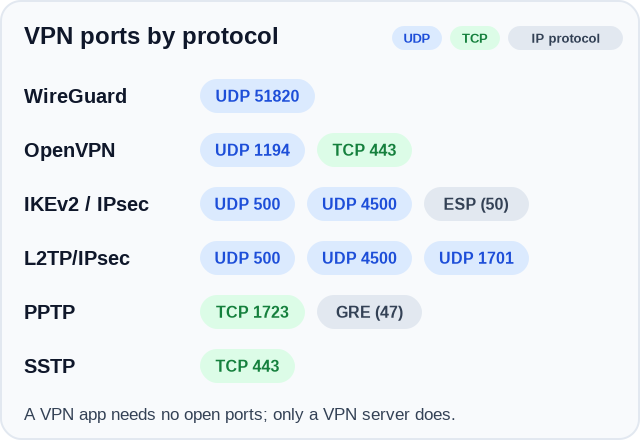
| Protocol | Port | Transport | Good to know |
|---|---|---|---|
| WireGuard | 51820 | UDP | Fast and modern; any UDP port works |
| OpenVPN | 1194 | UDP by default, or TCP | TCP 443 gets through most firewalls |
| IKEv2 / IPsec | 500 and 4500 | UDP, plus ESP (IP protocol 50) | Built into Windows, macOS, iOS and Android |
| L2TP/IPsec | 500, 4500 and 1701 | UDP, plus ESP | 1701 travels inside the IPsec tunnel |
| PPTP | 1723 | TCP, plus GRE (IP protocol 47) | Outdated; replace it with IKEv2 or WireGuard |
| SSTP | 443 | TCP | Windows; looks like HTTPS to firewalls |
ESP, AH and GRE are not ports
ESP, AH and GRE are IP protocol numbers (50, 51 and 47). A firewall needs a protocol rule for them rather than a port rule, and a port checker cannot test them.
Ports used by VPN apps and mesh networks
- OpenVPN Access Server: UDP 1194 and TCP 443 for VPN clients, TCP 943 for the web interface.
- Tailscale: UDP 41641 for direct connections, with relays over HTTPS 443 when a direct path is not possible.
- ZeroTier: UDP 9993.
- SoftEther VPN: TCP 443, 992, 1194 and 5555.
- Cisco Secure Client (AnyConnect): TCP 443, plus UDP 443 for DTLS.
- Fortinet FortiClient SSL VPN: TCP 443, often moved to 10443 on FortiGate.
- Palo Alto GlobalProtect: TCP 443, plus UDP 4501 for the IPsec tunnel.
Which VPN protocol should you use?
| Protocol | Best for | Through restrictive firewalls |
|---|---|---|
| WireGuard | Speed, phones and self-hosted servers | UDP only; use obfuscation where UDP is blocked |
| OpenVPN | Compatibility with almost every device and router | Good on TCP 443 |
| IKEv2 | Phones that switch between Wi-Fi and mobile data | Needs UDP 500 and 4500 |
| SSTP | Windows-only networks | Good, because it uses TCP 443 |
| PPTP | Nothing today | Replace it with IKEv2 or WireGuard |
PPTP port 1723
PPTP uses TCP 1723 to set up the connection and GRE (IP protocol 47) to carry the data. To host a PPTP server, forward TCP 1723 to it; GRE follows through routers that support PPTP passthrough. Some routers run their own PPTP server on 1723, so turn that off first.
PPTP's MS-CHAPv2 authentication can be cracked, which is why Apple removed PPTP from macOS and iOS in 2016 and new Windows Server 2025 deployments no longer accept it by default. Treat PPTP as unencrypted, and move to IKEv2 or WireGuard, which are faster as well as secure.
SSTP port 443
SSTP is Microsoft's VPN over HTTPS. It uses TCP 443 only, so it passes firewalls that allow web traffic, and the client is built into Windows. A Windows Server running Routing and Remote Access needs TCP 443 forwarded to it and a TLS certificate that clients trust.
Hosting your own VPN server
Forward only the port of the protocol your server runs, to the server's LAN IP: UDP 51820 for WireGuard, UDP 1194 (or a TCP port) for OpenVPN, UDP 500 and 4500 for IKEv2 and L2TP/IPsec. The guides for WireGuard, OpenVPN and IPsec walk through each one, and the port forwarding test checks TCP rules end to end.
Behind CGNAT, which is standard on Starlink, 5G home internet and many fiber ISPs, no router rule can reach your server. PureVPN's Port Forwarding add-on opens the port on the VPN server's public IP instead, so your own WireGuard or OpenVPN server keeps working; clients only change their endpoint.
Host a VPN server behind CGNAT
PureVPN + Port Forwarding
- Open the exact ports your server uses, such as UDP 51820 or 1194, up to 15 at a time.
- Keep your own server and client configs; only the endpoint changes.
- Dedicated IP option, so the endpoint never changes.
- 31-day money-back guarantee.
VPN blocked on Wi-Fi? Connect over a port that is always open
Hotel, airport and public Wi-Fi often allow only web traffic, TCP 80 and 443, and drop UDP 1194, 51820 and 500/4500. Some networks and countries go further and use deep packet inspection to spot VPN handshakes on any port. Two settings get you connected:
- Switch to OpenVPN over TCP 443, or another TCP port your app offers. That gets past networks that filter by port.
- Turn on obfuscation. It disguises the VPN as ordinary HTTPS, so it also gets past deep packet inspection.
| VPN | Feature | Ports |
|---|---|---|
| NordVPN | NordWhisper protocol and obfuscated servers | NordLynx UDP 51820; OpenVPN UDP 1194 or TCP 443 |
| Proton VPN | Stealth protocol: WireGuard inside TLS | TLS over TCP, like HTTPS |
| Private Internet Access | Choose the remote port in the app | UDP 8080, 853, 123, 53; TCP 8443, 853, 443, 80 |
Best for restrictive networks
NordVPN
- NordWhisper and obfuscated servers make the VPN look like regular web traffic.
- OpenVPN over TCP 443 when UDP is blocked.
- Apps for Windows, macOS, Linux, Android and iOS.
- 30-day money-back guarantee.
Stealth protocol
Proton VPN
- Stealth wraps WireGuard in TLS, so it connects on TCP-only networks.
- Available in the Windows, macOS, Android and iOS apps.
- Open-source apps, based in Switzerland.
- 30-day money-back guarantee.
Which VPN ports should be open?
- Using a VPN app needs no open ports on your router. Connections are outbound, so nothing has to be forwarded.
- On a VPN server, open only the port of the protocol it runs, and forward it only to the server's LAN IP.
- Upgrade PPTP to IKEv2 or WireGuard, and keep UDP 1701 closed to the internet unless your L2TP/IPsec server needs it.
- Allow management ports, such as OpenVPN Access Server's TCP 943, only from addresses you trust.
- Scan your public IP with the port scanner to confirm nothing else is exposed.
VPN ports FAQ
What ports does a VPN use?
It depends on the protocol: WireGuard uses UDP 51820, OpenVPN UDP 1194 or TCP 443, IKEv2 and L2TP/IPsec UDP 500 and 4500, PPTP TCP 1723 and SSTP TCP 443.
Do I need to open ports to use a VPN?
No. A VPN app makes outbound connections, so it works without port forwarding. Only a VPN server you host needs an open port.
Which ports should a firewall allow for VPN users?
Outbound UDP 51820 for WireGuard, UDP 1194 and TCP 443 for OpenVPN, UDP 500 and 4500 for IKEv2 and L2TP/IPsec, and TCP 443 for SSTP. Inbound rules are only needed on VPN servers.
What port does PPTP use?
TCP 1723 for control, plus GRE (IP protocol 47) for data. PPTP's authentication can be cracked, so IKEv2 or WireGuard are the modern replacements.
What port does SSTP use?
TCP 443, the HTTPS port, which is why SSTP gets through most firewalls.
Which VPN protocol is hardest to block?
Protocols that look like HTTPS on TCP 443: SSTP, OpenVPN over TCP 443, and obfuscated protocols such as NordVPN's NordWhisper and Proton VPN's Stealth.
What port does the built-in Windows VPN use?
It depends on the type: IKEv2 and L2TP/IPsec use UDP 500 and 4500, SSTP uses TCP 443, and PPTP uses TCP 1723 with GRE. The Automatic type tries them in turn.
What port does an SSL VPN use?
Usually TCP 443, which is why SSL VPNs such as Cisco Secure Client and FortiClient pass most firewalls. FortiGate setups often move SSL VPN to TCP 10443.
Which VPNs support port forwarding?
PureVPN lets you choose the ports with its Port Forwarding add-on. PIA and Proton VPN assign a random port, and NordVPN does not offer it on standard plans. See port forwarding behind CGNAT for details.
How do I check if a VPN port is open?
For TCP ports such as 443 or 1723, use the open port checker. WireGuard, OpenVPN and IPsec stay silent on UDP, so connect a client from mobile data or capture traffic on the server instead.
What VPN uses port 443?
SSTP, OpenVPN over TCP, SSL VPNs such as Cisco Secure Client and GlobalProtect, and VPN apps that offer OpenVPN over TCP 443, such as NordVPN. Port 443 is popular because firewalls rarely block HTTPS.
What are the best ports for a VPN?
For speed, the protocol's default UDP port: 51820 for WireGuard or 1194 for OpenVPN. On restrictive networks, TCP 443 works best because it is almost never blocked, and UDP 443 is a good second choice.
Which VPN ports do I need for gaming?
None to play online: a VPN app only connects out. To host a game server or get an open NAT type you need an inbound port, which a VPN with port forwarding can provide.
What is port 10443 used for?
It is a common alternative HTTPS port. FortiGate firewalls often run their SSL VPN on TCP 10443 so that 443 stays free for other services.
References
- Microsoft: Which ports to unblock for VPN traffic to pass through — PPTP, L2TP/IPsec, SSTP and IKEv2 ports and protocols.
- Microsoft: PPTP and L2TP deprecation — PPTP and L2TP retirement in Windows Server and the move to IKEv2 and SSTP.
- IANA Service Name and Port Number Registry — port 1194 assigned to OpenVPN.
- PureVPN: Port Forwarding add-on — choosing TCP and UDP ports to open on the VPN server.
Related tools
Related port guides
- WireGuard port 51820The WireGuard port, how to change and forward it, and fixes for failed handshakes.
- OpenVPN port 1194UDP 1194 or TCP 443, Access Server ports, port forwarding and TLS errors.
- IPsec ports 500 and 4500IKE, NAT-T and ESP ports for IKEv2 and L2TP/IPsec, and how to allow them.
- Port forwarding behind CGNATOpen a port for game servers, Plex or self-hosting when your ISP uses CGNAT.